
MISSOURI
From Site Selection magazine, July 2008

Leaving On a High Note
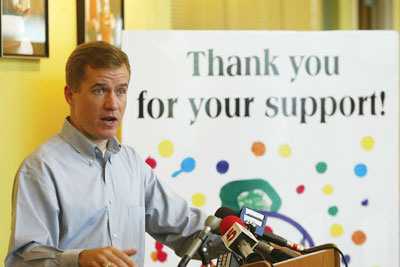
Gov. Blunt speaks to representatives from business, industry, education and government about the importance of job training that reflects the state's changing work force needs.
May was a busy but productive month for Missouri's General Assembly, particularly for those championing economic development measures through the legislature. Three bills of interest to the corporate location community passed - one designed to help land an aircraft assembly plant and two that expand existing incentives programs. Passage of the bills adds to a pro-business legacy Gov. Matt Blunt will leave behind - he announced in January that he will not seek re-election this fall. Following are excerpts of an interview with Gov. Blunt conducted May 30th. Site Selection: You now have two economic development bills before you. What do you like or not like about them?
Gov. Blunt: One bill increases the annual cap on tax credits the Department of Economic Development [DED] can authorize for the Enhanced Enterprise Zone Program from $14 million to $24 million and increases the cap on the Quality Jobs Tax Credit Program, which is definitely the most popular incentive that we have. We increased the cap last session from about $12 million to $40 million. This year, we'll be increasing it to $60 million. It helps ensure that we're incentivizing good-paying jobs with good benefits, and it's a very powerful incentive for the job creator. It's been a great success. Since I took office, we've netted about 80,000 new jobs in Missouri, and about 22,000 of those have some connection to the Quality Jobs Program.
I'm also excited about the bill we refer to as the mega project legislation. This legislation makes Missouri very competitive for a potential mega project that's out there. It definitely strikes a balance between a reasonable incentive but also a very powerful tool for this potential corporate partner that would create lots of new jobs. This bill takes us to the next level of large scale economic development, and it's focused around the 1,000-plus job opportunities that are out there. That bill is signed into law and the other will be signed by July.
SS: Was the mega projects legislation you signed into law recently controversial in that it was associated so closely with Bombardier, or was it widely understood to be good for the state regardless of Bombardier's decision? (At press time, Bombardier Aerospace had not yet announced a location for its planned aircraft assembly plant, which would create more than 2,000 jobs. A 108-acre/44-hectare site adjacent to Kansas City International Airport is among the contenders – Ed.)
Gov. Blunt: As with any large incentive, there were lots of good questions asked by members of the General Assembly that quite frankly I would have asked if I were a member of the General Assembly. Once those questions were answered, a strong majority in both chambers was comfortable that this was very important for the state and is perhaps the next step in letting folks know that Missouri is truly open for business and wants to support these really large job creators that are interested in mega projects that create entire new industries within our state.
There is a very exciting potential opportunity out there, and we need to pass legislation that puts us in a position where that opportunity can come here. Also, we don't want to say "No" to these opportunities when there is a chance to create well over 1,000 jobs at a very attractive compensation and create a whole new industry in the western part of our state. Aerospace has always been extremely important to Missouri's economy overall – we have suppliers all over Missouri, but a lot of it's focused around Boeing and defense-related work. This really creates new industry in western Missouri that will benefit the entire state.
SS: How will the transfer of business recruitment functions from DED to the Missouri Partnership affect companies considering a Missouri location?
Gov. Blunt: When I took office, one of our objectives was to ensure that we had a professional business recruitment effort and a professional DED, a less political one, and depoliticalization and professionalization of the department have been extremely important. We also stripped out a number of regulatory functions from DED and placed them elsewhere in government so that economic development could really focus on economic growth and job creation. We've looked at best practices across the country, and in some cases they not only professionalize business recruitment and economic development, in some ways they privatize them – and urge, sometime demand, that the business community itself become the driving force around recruitment to the state.
The Missouri Partnership is going to be one of the more significant accomplishments of the administration. We will have created a privatized entity, certainly not a government entity, that will be out there working with our corporate leaders and state government to bring businesses to Missouri. So it makes sense and is very much in line with what we've accomplished in depoliticizing the department, making it more professional and now working with the private sector in a new way and taking that to the next level as well.
"One of the strengths of the American economy - sometimes one of the frustrations - is that although states compete with one another, competition keeps us strong."
- Matt Blunt, Governor of Missouri
This will be very important. We have good leadership in Chris Chung, and it will be a great program. As I have said to corporate leaders, I would like to think it is helpful when the governor calls or the head of economic development calls. But I know it is helpful when another CEO calls to talk about, say, the work force in a very candid way, and strengths and maybe challenges that might be out there and how you can overcome them. I think it's extremely important that we enlist our corporate leaders in the process of economic development. They've been very enthusiastic about that. They see it as an act of corporate citizenship, and understand that strengthening a regional and state economy is good for everybody's business.
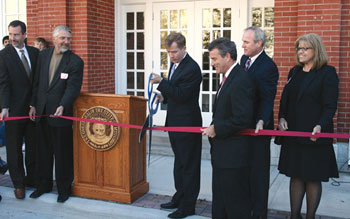
Gov. Blunt cuts a ribbon showcasing progress Excelsior Springs has made on its redevelopment and revitalization efforts since being named one of Missouri's first DREAM communities.
SS: How would you characterize the supply of workers in Missouri, especially those sought by high-tech industry?
Gov. Blunt: We have a strong, Midwestern work ethic. And we also understand that there are some challenges in terms of skills. That's why we've invested so dramatically in education. I've held government growth down – we've never increased taxes. In fact, we've cut taxes on manufacturing so that manufacturers aren't taxed on a lot of their inputs, like utilities. Government growth is at the lowest level of the previous eight administrations. But at the same time we've had a massive increase in education funding at every level, from pre-K to post-graduate education, and a real focus on what some states call STEM; in Missouri we call it "METS," for Math, Engineering, Technology & Science education with some very specific, targeted funding. The DED works closely with businesses, and our community colleges are exceptional and are working to meet the specific needs of industry. So we would tell any business interested in Missouri that there are challenges as there are with any state, but that Missouri and its partners in education are working together to address the work-force needs.
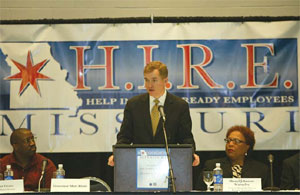
Gov. Blunt speaks to representatives from business, industry, education and government about the importance of job training that reflects the state's changing work force needs.
SS: To what extent are Missouri-educated college graduates, especially in high-tech fields, staying in the state after graduation?
Gov. Blunt: According to figures I saw recently, we have a net inflow of people with a Bachelor's degree, but we don't have a net inflow of people with advanced degrees. That's something we're continuing to work on – making sure we have the amenities the knowledge-based workers want to have in our state. Missouri is very culturally diverse with museums and professional sports teams, the kinds of amenities they are interested in.
SS: What is the significance of the DREAM (Downtown Revitalization and Economic Assistance for Missouri) Initiative?
Gov. Blunt: DREAM is very exciting. It's designed to help those small and medium-sized cities gain access to economic development tools. It's been very successful in that it takes a lot of existing resources and allows them to be pooled together to focus on a community. We're trying to go beyond fixing up one bad store front or fixing one sidewalk – those are important, but we believe there will be a powerful impact on a community's downtown when all of the tools are working together in a concerted way. The first 10 DREAM communities have received about $38 million in public investment, funds that were already available. That amount brought about $189 million in private investment. We are definitely committed to the DREAM Initiative. It has been the sort of success our small and mid-sized citied would demand, because they understand the importance of bringing those tools together and allow the communities to become self-sustaining. Ultimately it will have a much more powerful impact than the scattered approach where everybody gets a little bit. One benefit is that we're getting people to live in these downtowns, and that sends the right message to people looking at a community.

The redevelopment of the Oaks Apartments in Excelsior Springs is one result of the state's DREAM Initiative (www.dream.mo.gov), which has seen $38 million in state funds attract an additional $189 million in private investment to downtowns in 10 Missouri cities.
SS: Your decision to not seek another term as governor caught many off guard. What are your plans for after you leave office?
Gov. Blunt: I'm not sure yet about my plans. I love economic development. The creation of jobs is what makes everything else possible. I'm really proud of what we've accomplished in what will have been four years. I feel in a lot of ways that we've done what we set out to do and in some cases more, and so it's time to move on. It's been a great experience, and I'm very grateful to the people of Missouri. My wife and I will always treasure the opportunity we have had.
It's important to remind people that beyond some of the specific things like Quality Jobs and the expanded enterprise zone measures, the most important thing we did was level the playing field for everybody by passing a very strong tort reform measure and workers' comp reform that has led to about a 10-percent reduction in those rates. Those factors that have improved the overall business climate are absolutely vital.
SS: The point was made in different ways at the Republican Governors Association conference last November (Editor in Chief Arend and Gov. Blunt were co-panelists at a conference session) that states and their governors are in a better position to enact positive economic and other types of change than the federal government is. How can states be more proactive in promoting economic growth?
Gov. Blunt: One of the strengths of the American economy – sometimes one of the frustrations – is that although states compete with one another, competition keeps us strong. The fact that Missouri has to be competitive with Kansas and Oklahoma and Nebraska, indeed all 50 states, is pretty powerful. Across the state of Missouri, people are frustrated with Washington, D.C.'s ability to get anything done. It's the case today with the Congress, it was the case two years ago with the Congress. People want to see some action on some basic things that affect their lives. States generally are delivering that. I would argue that states with Republican governors are more likely to enact good, pro-business, pro-job reforms that allow for economic growth, low taxes and smaller government. States are responding much more rapidly to those challenges than is Washington, D.C.
