

EMERGING MARKETS
From Site Selection magazine, May 2008
Built for
Growth
Growth
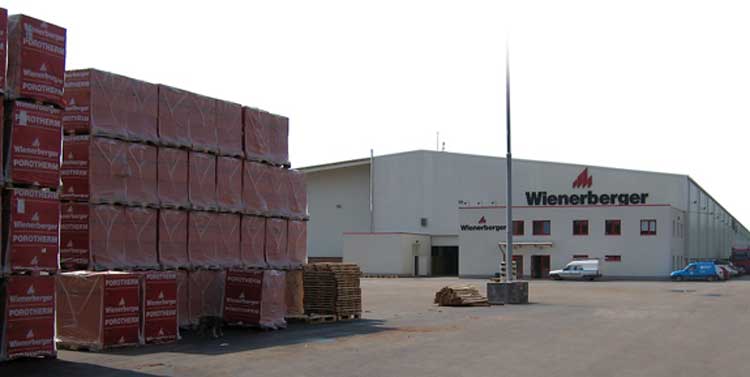
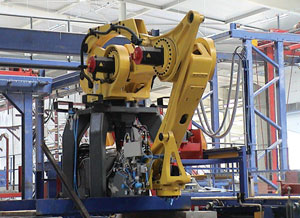
Weinerberger has invested heavily in Eastern European projects in recent years, including a plant in Gura Ocnetei, Romania.
W
einerberger, the Austria-based global brick manufacturing leader, lists the world's emerging markets among its list of growth markets. During 2007, the company invested more than €500 million (US$792 million) in growth projects, much of it in Eastern Europe and Asia. The company's 2008 outlook, released on March 26, forecasts continuing growth, especially in Eastern Europe. Wienerberger currently operates 268 factories in 26 countries.
"Our strategy focuses on growth markets in Central-East Europe such as Poland, Bulgaria, Romania, Balkan States, Ukraine and Russia, as well as on emerging markets such as India, where we began construction of a plant in Bangalore last year," says company spokeswoman Karin Hoffman.
"Our business model is designed to ensure that we only invest in profitable growth projects," she says. "We distinguish between bolt-on projects – new plants, extension of capacity, smaller acquisitions in existing markets – and external projects, [which are] acquisitions that justify a higher investment for strategic reasons – market position, entry in new markets. These projects form the basis for further bolt-on projects in later years."
Wienerberger assesses brick demand, level of new residential housing construction, macroeconomic drivers such as GDP, consumer confidence and, to a lesser extent, long-term interest rates and availability of raw materials.
Hoffmann says Wienerberger expects the growth in Eastern Europe to continue through 2008 and beyond. She cites Poland, Romania, Bulgaria, the Czech Republic, Slovakia and Russia as growth countries. In Wienerberger's 2008 forecast issued on March 26, the company says growth in Eastern Europe will help offset a weakness in North America due to a decline in residential construction.
Another building materials heavyweight, France-based Lafarge, also has big growth plans in emerging markets. The company invested heavily in cement capacity expansion in Morocco, China, Zambia, Indonesia, India, Ecuador, South Africa, Egypt and Poland during 2007.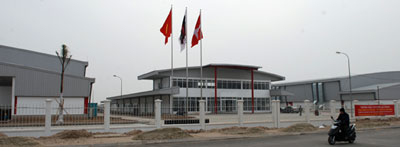
 Lafarge plans to build six cement plants in China by the end of 2010, an investment of more than €600 million ($950 million).
Markets Show Resilience
Data supporting the emerging markets trend comes from the Institute of International Finance. The IIF estimates that net private capital flows to emerging markets rose to $782 billion in 2007 from the previous record level of $568 billion in 2006. The IIF forecasts that the 2008 total will be $731 billion, explaining that the moderation from 2007 largely reflects the general slowdown in global economic growth.
"The forces of globalization and the pursuit of sound economic policies by many emerging markets countries have resulted in record levels of net private capital flowing to these countries now," said Dr. Josef Ackermann, Chairman of the Institute of International Finance's Board of Directors, at a recent IIF meeting in Rio de Janeiro. "A major rise in these flows was seen last year, and even with a slowing global economy, the scale of capital likely to flow to emerging markets in 2008 will be formidable,"
Ackermann, who is also chairman of the Management Board and the Group Executive Committee of Deutsche Bank AG, said that, given the slowing pace of growth in the U.S., EU and Japan, emerging markets will be an important source of support for global economic growth in 2008.
The IIF said that direct investment into emerging economies is currently on an upswing, with net inward FDI to total $286 billion this year, compared to an estimated $256 billion in 2007 and $167 billion above the 2006 volume. The IIF noted that the strength of FDI comes despite an evident rise in global corporate caution in recent months. China once again is expected to lead the way, receiving net $88 billion. The IIF report noted that FDI flows to Latin America this year are likely to match last year's record of around $55 billion.
Very Outgoing
OCO Global, a foreign direct investment consultancy, cites the continuing success of emerging countries such as China, Russia and Vietnam in attracting investment in a recent report on 2007 FDI data. OCO Global reports that China retained its position as the world's top destination for multinational investment, attracting $90 billion in projects, down from a peak of $116 billion in 2006. Of an estimated 1.2 million jobs created in the Asia-Pacific by FDI in 2007, China drew 366,000, compared to 246,000 for India.
But OCO says the investment train is just as likely to be leaving the station as arriving there.
"In terms of FDI opportunity and recruitment in emerging markets, the approach is different from more established economies in a number of ways," says Mark O'Connell, CEO of OCO Global, of outgoing investment from emerging-market countries. "You have to be a market marker – there is limited latent untapped demand for FDI, and since these economies are usually growing fast, the offer must be pretty compelling to distract them from the domestic opportunity. The site selection process is not a sophisticated one and is often driven more by practicalities such as ease of getting visas, the presence of an expat community in the destination country, historical and cultural links.
"There are a number of large resource- and asset-seeking investors from emerging markets such as Tata, Reliance, Huwaei, Petrobas and Gazprom who need high-level political courtship, not necessarily IPA level engagement," continues O'Connell. "However these larger firms tend to account for the lion's share of projects from emerging markets. China, India and Russia created 8,000 jobs in the U.S. in the last five years, of which more than half were created in 2007. So, albeit from a small base, the trend is very positive."

"Our strategy focuses on growth markets in Central-East Europe such as Poland, Bulgaria, Romania, Balkan States, Ukraine and Russia, as well as on emerging markets such as India, where we began construction of a plant in Bangalore last year," says company spokeswoman Karin Hoffman.
"Our business model is designed to ensure that we only invest in profitable growth projects," she says. "We distinguish between bolt-on projects – new plants, extension of capacity, smaller acquisitions in existing markets – and external projects, [which are] acquisitions that justify a higher investment for strategic reasons – market position, entry in new markets. These projects form the basis for further bolt-on projects in later years."
Wienerberger assesses brick demand, level of new residential housing construction, macroeconomic drivers such as GDP, consumer confidence and, to a lesser extent, long-term interest rates and availability of raw materials.
Hoffmann says Wienerberger expects the growth in Eastern Europe to continue through 2008 and beyond. She cites Poland, Romania, Bulgaria, the Czech Republic, Slovakia and Russia as growth countries. In Wienerberger's 2008 forecast issued on March 26, the company says growth in Eastern Europe will help offset a weakness in North America due to a decline in residential construction.
Another building materials heavyweight, France-based Lafarge, also has big growth plans in emerging markets. The company invested heavily in cement capacity expansion in Morocco, China, Zambia, Indonesia, India, Ecuador, South Africa, Egypt and Poland during 2007.
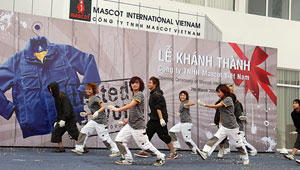
Foreign investors increasingly look to Vietnam for a manufacturing base. A thriving sector there is textiles and apparel. Danish workwear manufacturer Mascot recently opened a 650-employee, 161,550-sq.-ft. (15,000-sq.-m.) factory about 31 miles (50 km.) from Hanoi.
Markets Show Resilience
"The forces of globalization and the pursuit of sound economic policies by many emerging markets countries have resulted in record levels of net private capital flowing to these countries now," said Dr. Josef Ackermann, Chairman of the Institute of International Finance's Board of Directors, at a recent IIF meeting in Rio de Janeiro. "A major rise in these flows was seen last year, and even with a slowing global economy, the scale of capital likely to flow to emerging markets in 2008 will be formidable,"
Ackermann, who is also chairman of the Management Board and the Group Executive Committee of Deutsche Bank AG, said that, given the slowing pace of growth in the U.S., EU and Japan, emerging markets will be an important source of support for global economic growth in 2008.
The IIF said that direct investment into emerging economies is currently on an upswing, with net inward FDI to total $286 billion this year, compared to an estimated $256 billion in 2007 and $167 billion above the 2006 volume. The IIF noted that the strength of FDI comes despite an evident rise in global corporate caution in recent months. China once again is expected to lead the way, receiving net $88 billion. The IIF report noted that FDI flows to Latin America this year are likely to match last year's record of around $55 billion.
Very Outgoing
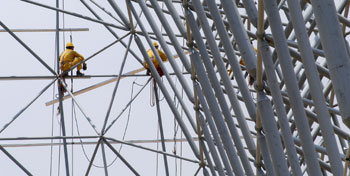
French building materials conglomerate Lafarge is investing heavily in projects in emerging markets, such as this plant in Chilanga, Zambia.
But OCO says the investment train is just as likely to be leaving the station as arriving there.
"In terms of FDI opportunity and recruitment in emerging markets, the approach is different from more established economies in a number of ways," says Mark O'Connell, CEO of OCO Global, of outgoing investment from emerging-market countries. "You have to be a market marker – there is limited latent untapped demand for FDI, and since these economies are usually growing fast, the offer must be pretty compelling to distract them from the domestic opportunity. The site selection process is not a sophisticated one and is often driven more by practicalities such as ease of getting visas, the presence of an expat community in the destination country, historical and cultural links.
"There are a number of large resource- and asset-seeking investors from emerging markets such as Tata, Reliance, Huwaei, Petrobas and Gazprom who need high-level political courtship, not necessarily IPA level engagement," continues O'Connell. "However these larger firms tend to account for the lion's share of projects from emerging markets. China, India and Russia created 8,000 jobs in the U.S. in the last five years, of which more than half were created in 2007. So, albeit from a small base, the trend is very positive."
Site Selection Online – The magazine of Corporate Real Estate Strategy and Area Economic Development.
©2008 Conway Data, Inc. All rights reserved. SiteNet data is from many sources and not warranted to be accurate or current.
©2008 Conway Data, Inc. All rights reserved. SiteNet data is from many sources and not warranted to be accurate or current.