
PACIFIC NORTHWEST
From Site Selection magazine, January 2009

Native Corporations
Flex Economic Muscles
Flex Economic Muscles
I
f your organization's foray into Alaska involves energy or construction services, tourism, telecommunications, electrical contracting, environmental consulting and remediation or real estate development, it will likely be working with one or more of the state's regional or village native corporations. Formed by the Alaska Native Claims Settlement Act of 1971 as an alternative to the reservation model implemented for native populations in the lower 48 states, these corporations today are powerful economic engines from the metropolitan Anchorage area to the energy-rich North Slope. Some of the larger of the 13 regional corporations have surpassed the US$1-billion-in-revenue per year mark and are on their way to being among the top economic forces in the state.
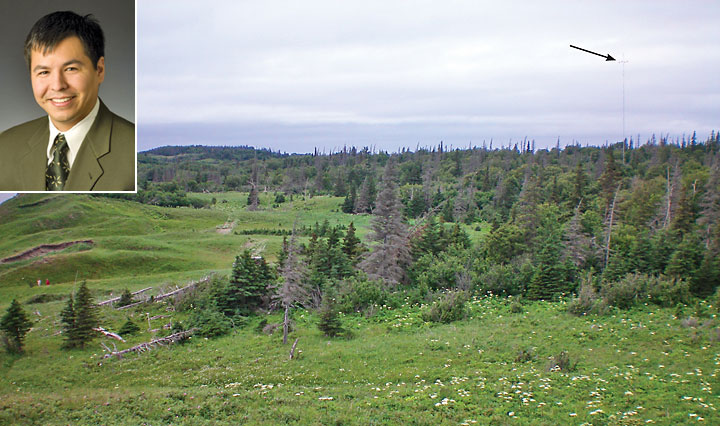
A wind-speed instrument (indicated with arrow) gathers data in preparation for installation of windmills on a bluff on Fire Island in Cook Inlet near Anchorage. The project is a joint venture of renewable energy company enXco Inc. and native corporation Cook Inlet Region Inc. (CIRI), where Ethan Schutt (inset) works as senior vice president, land and legal affairs.
Village corporation land on the Arctic Slope is naturally valuable with oil and gold beneath it, but savvy players elsewhere are no less fortunate.
"The lands we received are in an urban area," says Curtis McQueen, CEO of Eklutna, Inc., based in Eagle River near Anchorage. "As the city grows and expands and needs more residential, commercial and industrial land, we're the only game in town." Eklutna used to sell or lease land, and that was the extent of its role in Anchorage's growth.
Infrastructure Impetus

A
laska Airlines flight #674 (pictured) left Seattle for Denver on the afternoon of Nov. 20, officially breaking in the new $1-billion third runway at Seattle-Tacoma International Airport. "The runway is expected to save over 5 million gallons of fuel for airlines and over 50,000 tons of greenhouse gases per year," said John Creighton, Port of Seattle commission president. "Most importantly, it will reduce delays and save millions of dollars for airlines as well as time for passengers."
Sea-Tac's 8,500-ft. (2,590-m.) runway is expected to reduce arrival delays by up to 80 percent. It is far enough away from the easternmost runway to allow two streams of traffic to occur in virtually all weather conditions. The Port of Tacoma also has also embarked on a major expansion, redeveloping the Blair-Hylebos Peninsula in a $1-billion project that will boost cargo capacity. The Port's improved infrastructure will help ongoing industrial expansion, which includes the recent opening of a 646,000-sq.-ft. (60,000-sq.-m.) regional distribution center in the Port's Frederickson Industrial area by Swedish home furnishings retailer IKEA.
– John McCurry
Now, he says, land is in shorter supply, and Eklutna has more skin in the game. "The way the corporation is going now, we will be a design-build, turnkey developer for you. We have enough leverage to do the site work, build the building and have a few more profit centers for our corporations than we've had in the past."
Like its larger, regional counterparts, Eklutna is in several lines of business, from residential and commercial development to supplying sand and gravel to private and public developers to leasing space at its 155-acre (63-hectare) Birchwood Industrial Park in Eagle River. The Alaska Railroad Corp. is helping generate interest in the park, which has rail access north to Fairbanks and south to the Port of Anchorage, which is in the midst of a $700-million expansion. Interest in industrial space at Birchwood and elsewhere is on the upswing as a $26-billion natural gas pipeline project moves closer to becoming reality.
"Where are you going to store that pipe when it comes in from the port and needs to be sent up to Fairbanks, and where do you store the construction equipment?" notes McQueen. One tenant at Birchwood is building prefabricated houses for use in rural Alaska; the rail link can send them north to the interior or south to the port for shipment by water to points in western Alaska. More interest in the site is coming from Asian companies needing transshipment centers and exporters sending seafood and such raw materials as coal and timber back home.

Curtis McQueen, CEO, Eklutna, Inc.
Another Perspective on Land Availability
Popp says a "fairly significant amount of acreage and buildings" is still available in Anchorage under several different ownership entities.
"On balance, while Eklutna has brought an important new land resource to market, there is still a significant and competitive market for land and buildings," he stresses. "The Port of Anchorage is adding about 130 acres [53 hectares], and we're also getting some preliminary signals from the military that they are making some of their land available for private-sector leases for light industrial classification on some of their fairly substantial acreage along some of the major highway corridors, particularly the Glenn Highway. They haven't finalized plans, but an initial look is being taken at that idea."
The Renewable Energy Play
As with other renewable energy projects in the works, the long-term benefits of the Fire Island project in today's lower-cost-of-oil context look rosier than short-term benefits envisioned when the project was getting under way and oil prices were on the march.
"In the long term, it's not jobs intensive, and the cost of power probably will come in relatively competitively with current costs of power based on natural gas burn," says Ethan Schutt, CIRI's senior vice president, land and legal affairs. "Over the long term, the economic benefit is predicated on rising fuel prices as opposed to a flat, non-fuel charge for the wind."

Site Selection Online – The magazine of Corporate Real Estate Strategy and Area Economic Development.
©2009 Conway Data, Inc. All rights reserved. SiteNet data is from many sources and not warranted to be accurate or current.
©2009 Conway Data, Inc. All rights reserved. SiteNet data is from many sources and not warranted to be accurate or current.