|
Week of September 24, 2001 Special Report |
|
Attack on America: The Industry Responds 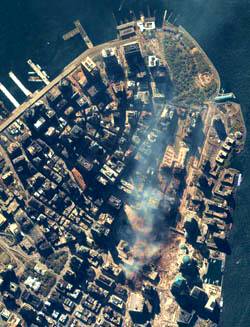 Real Estate Strategy,
Post-09/11/01: In Part, a Whole New Ballgame
By JACK LYNE • Site Selection Executive Editor of Interactive Publishing
"After what's happened, everyone is reappraising almost everything vis-à-vis facilities and location," said John Heffron, partner and national director of construction services for Ernst & Young Real Estate Advisory Services (E&Y at www.ey.com).
Real estate strategy is certainly part of the orbit of the ubiquitous reappraisal spurred by Sept. 11's terrorist attacks. Parts of the industry's overarching strategy may soon shift so markedly that, for some aspects, there could be a clear delineation: pre-09/11/01 vs. post-09/11/01. WTC post-09/11/01: A one-meter resolution satellite image of Manhattan, (pictured above), this one taken on Sept. 15, 2001. Photo courtesy spaceimaging.com
"Clearly, I think there will be some consideration of relocating part of some headquarters operations to a less visible location," said Ernst & Young's Heffron (pictured above).
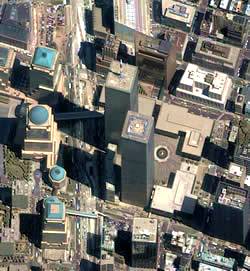
The impetus for the decentralization push lies in the large number of major corporate clusters located in the World Trade Center area. Of the 1,300 businesses affected by the attack, 31 displaced tenants occupied 100,000 sq. ft. (9,000 sq. m.) or more. Four of them - American Express, Merrill Lynch, Morgan Stanley Dean Witter and Salomon Smith Barney - occupied 1 million sq. ft. (90,000 sq. m.) or more. E&Y's Heffron agreed that increased dispersal will be part of post-09/11/01 strategy, but predicted a well-defined focus. WTC pre-09/11/01: Taken on June 30, 2000, this one-meter resolution satellite image of Manhattan (pictured above) prominently featured the 110-story World Trade Center Towers. Photo courtesy spaceimaging.com
"The tendency toward dispersal will grow," Heffron said, "but only in terms of large, critical concentrations of 3,000 to 4,000 white-collar workers located in central business districts (CBDs) in first-tier cities. We'll probably see far fewer companies taking 20 floors in one high-rise in a first-tier city."
Which Way for Headquarters? Some observers also anticipate dispersal of headquarters facilities."Some global firms may consider a greater regional or even international dispersal of headquarters activities to avoid damage to their businesses," Jones Lang LaSalle said. Heffron foresees a somewhat less drastic headquarters realignment. "Dispersing a headquarters is much tougher than relocating one," he said. "Clearly, I think there will be some consideration of relocating part of some headquarters operations to a less visible location," Heffron continued. "For example, company XYZ might leave a shell headquarters in New York, with 90 percent of the headquarters people relocated in the real operation in, say, New Jersey. The 10 percent left at the shell headquarters would be those who needed face time with the surrounding businesses." Some real estate analysts have predicted diminished location appeal for CBDs in Sept. 11's wake. Few, however, see CBDs disappearing. Said Jones Lang LaSalle International Director and Co-chair of Global Research Jacques Gordon, "The firm does not foresee a flight of occupiers and capital from central business districts. However, new demand will be stronger in suburban markets than in CBDs. "For example, even after many terrorist bombings, the city of London remained a preferred location," he continued. "However, suburban locations were also treated more seriously as occupancy alternatives." "In the short run, some people have to be considering locating out of CBDs, more so on major new projects. But there will always be a need for CBDs," Heffron contended. Greater Telecom Use Wherever their location, many facilities will likely make greater use of telecommunications, as they did in the days following Sept. 11.AT&T, for example, reported a 20 percent increase in its teleconferencing business in the week following Sept. 11. A Prudential videoconferencing center in Norwalk, Conn., reported a doubling of business over that same time frame. Among those virtual meetings at the Prudential center, which rents to the public at $350 to $450 an hour, was an eight-hour conference. Heffron thinks that greater use of telecommunications "might offset to some extent" the costs of dispersing operations. Less certain is how increased telecom usage would impact transactions in real estate, a business culture in which "you can't fax a handshake" is a durable maxim. Military crises, however, have a history of speeding the adoption of new telecom technologies, according to Rutgers communications professor James Katz. Acceptance of the telegraph, for example, accelerated after Northern military forces used it to coordinate troop movements in the U.S. Civil War. "I think we may be surprised by how well we adjust [to greater telecom use]," Heffron said. "Functions that previously felt that they had to have face-to-face contact will probably adapt with far less difficulty than they imagined." The U.S. stock market has already taken note of the greater use of teleconferencing, videoconferencing and Internet-based collaboration after Sept. 11. Several players in that sector, including Picturetel, Polycom and Webex, have seen their share prices rise. Sept. 11 may also speed the adoption of remote work, both from satellite offices and employee homes. "I think you're going to see flexible work arrangements come to the fore as more of the norm," said Chris Steele, senior manager of New York-based Ernst and Young Real Estate Advisory Services. Virtual givens in post-09/11/01 real estate are tighter security and higher insurance premiums for property, most observers agree. Some previously announced projects may also change in light of Sept. 11, Heffron asserted. "I think everyone will be reassessing projects that are in the pipeline in terms of the facility specification and configuration and the employee volume," he said. "My supposition is that some of them, depending on the location, may be scaled down." More articles related to September 11 terrorist attacks on America  PLEASE VISIT OUR SPONSOR • CLICK ABOVE PLEASE VISIT OUR SPONSOR • CLICK ABOVE
©2001 Conway Data, Inc. All rights reserved. Data is from many sources and is not warranted to be accurate or current.
|
 It's far too early to know, however, just how real estate's post-09/11/01 incarnation will shape up. In perhaps one of the more salient points, Heffron, "We're going to overreact at first."
For the moment, there's certainly no shortage of opinion over Sept. 11's impact.
It's far too early to know, however, just how real estate's post-09/11/01 incarnation will shape up. In perhaps one of the more salient points, Heffron, "We're going to overreact at first."
For the moment, there's certainly no shortage of opinion over Sept. 11's impact.
 Which Operations Will Disperse?