|
Week of October 1, 2001 Special Report |
|
Attack on America: The Industry Responds FEMA Worker Describes Agency's Response at WTC Site By JACK LYNE • Site Selection Executive Editor of Interactive Publishing
The selfless work of rescue teams at the WTC site has redefined heroism as very much a real-life phenomenon. FEMA News Photo by Michael Rieger
Others, though, came from far away to lend a hand in the wake of the worst mass murder in U.S. history. This week we talked to one of them: Paul Golden, a reserve "DAE" - Disaster Assistance Employee - with the Federal Emergency Management Agency (www.fema.gov), as well as an officemate of ours here in Atlanta.
From Jury Duty to Emergency Rescue As with most Americans, Golden's Sept. 11 began with ostensible normalcy. He was sitting in an Atlanta-metro courthouse, having been called for jury duty."Suddenly, they put down a very large TV in front of us and said, 'You'd better watch this'," he recalled. "What we saw was the first World Trade Center tower burning." For most, the sight stirred deep horror. For Golden, though, it was also a call to action. He immediately got on his cell phone and called FEMA's Southeast regional headquarters in Atlanta to see if his unit was being activated. FEMA told Golden to immediately report to the Southeast headquarters. "Our first job [at the regional headquarters] was to call all the state emergency operations centers and advise everybody to be in a high state of readiness," he recalled. "We didn't know then what was happening elsewhere. We didn't know where we were going to be hit in those first few hours." Momentarily, FEMA also didn't know its exact role. As FEMA Public Affairs Officer Mark Wolfson explained, "Immediate response to a situation like the one in New York City and in Washington comes from the local first responders. FEMA is in the background to support them. We're in constant contact with the folks that are on the front lines and whatever they need, we'll be there to help them." Echoed Golden, "We are trained and we firmly believe that all disasters are local. Local people are the first ones to have to deal with a disaster, and they're the last ones to have to deal with it." Before Sept. 11 was done, though, FEMA had been called in. On the day of the attacks, the agency deployed eight Urban Search and Rescue Teams to New York and four to Washington. FEMA called up its reservists on the basis of their expertise. Golden, an expert in disaster recovery logistics, was among those called. FEMA "prioritized" his flight status to get him on the first plane out of Atlanta after Sept. 11's shutdown. He left on a 4 a.m. flight on Sept. 15, headed for New York.
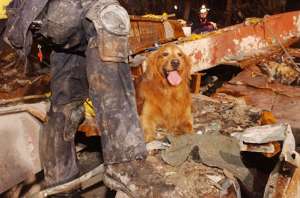
'Disaster Offices on Wheels' Typically, FEMA moved swiftly to set up a disaster field office in New York."FEMA has what you'd call breakout kits," Golden explained. "They're literally disaster offices on wheels. We have dozens of tractor/trailer vans around the U.S. that are loaded with entire disaster field offices. There's everything imaginable in those vans - wireless telephone systems, hundreds of laptop computers, chairs, desks, partitions, paper, staples, and clipboards. It's a total turnkey operation that can supply a disaster office of up to 1,000 people." The work of FEMA's "Canine Search Specialists" (pictured above) and their trainers "was one of the most inspirational things" at the WTC attack site, Golden said. FEMA News Photo by Andrea Booher
Those "disaster offices on wheels" can be on the road within two to three hours of a disaster. Once they arrive at their destination, they can be fully up and running in 24 to 48 hours.
FEMA's New York disaster field office was in Manhattan at Pier 90, on 12th Avenue and 55th Street, two miles (3.6 km.) from ground zero. The city had secured the space. Pier 90 proved to be an opportune location - particularly for coordinating with the city and the state, which had set up their disaster relief office in the adjacent Pier 92. In addition, the victim's services office, with which FEMA would also repeatedly interface, was inside Pier 94.
'Get It Done, Worry About the Cost Later' In essence, FEMA's New York office was, as Golden described it, "a coordinating agency, coordinating all the other federal support agencies."Those agencies ranged from the General Services Administration to the Corps of Engineers to the U.S. Forest Service to the Centers for Disease Control. All told, FEMA "has been coordinating the response support of 27 different departments and agencies," Wolfson noted.  "State and local agencies come to us with specific requests," Golden explained. "Essentially, they have access to all the resources of the government of the United States of America. We then go out to the different agencies and tell them what was requested and see who has the resources to meet the need. "At that point, we aren't worrying about cost," he added. "Our philosophy is to get it done and worry about the cost later." Some of the requests to the agency were filled through expected avenues - particularly FEMA's nationwide network of warehouses, which are stocked with supplies for emergencies. Other requests were more unique to the situation. President Bush (pictured above) visited FEMA headquarters on Oct. 1 and told workers, "Yours was an organization that was used to dealing with generally acts of nature -- hurricanes, or tornadoes, or fires or floods. Now, all of a sudden, some evil people came and they declared war on America. And your agency, and the good working people, true Americans, had to rise to the occasion. And rise you did." FEMA News Photo by Doug Hill
FEMA, for example, provided laser systems that were attached to the edge of the buildings that had been damaged in the attacks. The lasers were calibrated so that they would set off a warning alarm if any of the damaged buildings' foundations moved as much as a millimeter.
FEMA also provided infrared sensors to map the attack area. Rescue teams hoped that the infrared images of the debris would reveal some open-space cavities, which might allow some of the missing to survive.
'Brute Force and Experience' FEMA's Disaster Assistance Employees don't fit the images of the heroes that we've seen working at the disaster sites. They're considerably older. DAEs generally have 20 to 30 years of experience, and they've been chosen by FEMA precisely for that expertise."Ninety-nine percent of what we do is logistics," said the 53-year-old Golden. "We're not the guys who are young and strong enough to be out at ground zero. Our strength is in our expertise." Golden served as assistant to the chief of operations at FEMA's disaster relief office, as well as serving as special liaison to the city and state. Of the latter, he said, "That meant basically that I did special projects. They would say, 'Golden, go fix this.' " "One thing that happened a lot in the first few days, which were quite chaotic, was that the same thing would, apparently, be requested by three or four different groups," he continued. "It was my job to make sure whether they were duplicate requests or separate requests. Then I had to make sure there were no delays on projects, or fix them if they came up. It's not elegant in the first few days after a disaster. You do it with brute force and experience." Stomping Out 'Slimebags,' Processing Claims FEMA ultimately sent 20 of its 28 Urban Search and Rescue teams to New York. Eight teams, however, were the most in the city at any one time. FEMA rotated the teams in and out, giving relief to workers who had been working 12- to 14-hour shifts every day. "You literally had to drag people away from the work to make them get rest," Golden said.FEMA has pulled back its presence since the New York and Washington work has moved from rescue to recovery. One Urban Search and Rescue team now remains in New York. The agency's efforts now move in part to monitoring for fraud, Golden said: "From our experience, there are some slimebags who will come out of the woodwork and try to take advantage of these things." FEMA will also continue working in processing claims at the disaster sites. As of Oct. 1, the agency had committed more than $344 million to the response and recovery effort in New York. Those funds have gone to "address immediate needs such as emergency services, debris removal, disaster housing grants and special mission assignments to other federal agencies," according to FEMA officials. "FEMA will be here until the very bitter end," vowed agency Director Joseph Allbaugh. (To inquire about eligibility for FEMA assistance, call 1-800-462-9029.) Despite Horror, 'System Worked' Ironically, Golden wasn't all that keen on FEMA at one point during his 27 years in the U.S. Coast Guard. (He retired as a captain.)"I remember 20 years ago, if someone said that FEMA was in charge, people in the armed forces would say, 'Yeah, sure. Just stay out of our way.' Back then, it was a bureaucratic, check-writing entity with no track record and no staff of experts. "But it's evolved tremendously in the last 20 years into a very efficient entity with professional, experienced people." Golden expects FEMA to undergo yet more changes in the wake of Sept. 11. "With the magnitude of this, we're probably looking at a whole new ballgame," he said. "What you'll probably see is more emphasis on urban search and rescue and public health issues such as biochemical threats. We've seldom had to emphasize those as much as we have since Sept. 11." But even in an unprecedented disaster, the center of gravity held, Golden asserted. "I was very happy and very proud to see that federal agencies took all the necessary actions and that everyone stayed calm," he said. "We went to checklists, contingency plans - the underlying foundation. "It's never pretty the first few days. But even in a horrible situation, the system worked." More articles related to September 11 terrorist attacks on America  PLEASE VISIT OUR SPONSOR • CLICK ABOVE PLEASE VISIT OUR SPONSOR • CLICK ABOVE
©2001 Conway Data, Inc. All rights reserved. Data is from many sources and is not warranted to be accurate or current.
|