

ALTERNATIVE ENERGY HUBS
From Site Selection magazine, May 2009
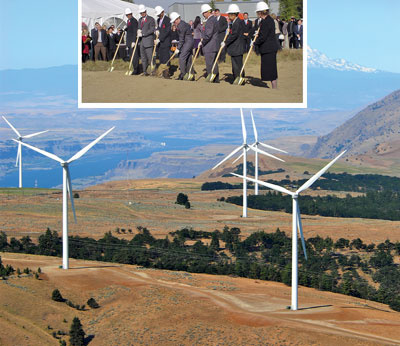
Oregon and Washington have strong alternative energy momentum in both wind and solar, as demonstrated by the October groundbreaking for SANYO Solar's $80-million silicon ingot and solar wafer manufacturing facility in the Salem Renewable Energy and Technology Park (inset), the state's sixth solar facility location in 16 months, and by RE Power Systems wind turbines at the Goodnoe Hills wind farm in southern Washington.
The Quest for Grid Parity
W
hat's the best ingredient for an alternative energy plant? Expensive electric power, says an expert who has traveled the globe to serve the site selection needs of renewable energy companies.
The key industry to watch is solar power, says Don Schjeldahl, vice president and director of Austin Consulting in Cleveland, Ohio. "Where will the solar energy industry be located in the future? What will drive it? It won't be the European or Japanese model, which was to provide substantial incentives and feed-in tariffs to subsidize the electric power costs," says Schjeldahl, who heads up Austin's Renewable Energy Strategic Industry Group.
"We tend not to do that in the U.S. What must drive the market in the U.S. is grid parity – the idea that solar can be competitive with grid-bought power," he says. "Investment tax credits are very important, but ultimately the price of installed solar must be competitive with grid power."

Turbines or not, Glenn has provided power to the state's economy for a long time. As of April, it employed 1,508 full-time permanent employees, 17 part-time permanents, 64 term appointments and 17 students via co-op arrangements, for a total of 1,631 on the payroll.
"NASA Glenn continues to be an important economic player in Northeast Ohio and across the state," writes U.S. Sen. George Voinovich in an e-mail. "It is a vital component for both NASA and greater northeast Ohio, and I continue to support it. In fact, I recently led a letter with the Ohio delegation expressing a desire to work with President Obama to strengthen the presence of NASA in Ohio. I encouraged him to pay particular attention to the Glenn Research Center and its testing facility, Plum Brook Station.
"While my Ohio colleagues and I are excited by all the work that has been done to date, it is but the beginning of opportunities that will span generations," writes Voinovich. "Ohio has a skilled engineering labor force and manufacturers that have proven themselves on multiple NASA flight projects. When combined with NASA Glenn's experienced federal work force and world-class facilities, Ohio is a competitive choice for the location of additional contract and sub-contract work in design, development, manufacturing and testing."
Could it have a role in the renewable energy sector itself?
"Many people don't know this, but between 1974 and 1981, NASA Lewis/Glenn led the U.S. Wind Energy Program for large wind turbines," answers Voinovich. "The technologies that were developed at Plum Brook Station and in Cleveland, Ohio, during this time period have paved the way for the advanced wind energy components being deployed by domestic manufacturers like GE, Owens Corning and others. Today, NASA Glenn continues to demonstrate technical excellence in the renewable energy field. Power research, technology and development at Glenn are addressing a wide range of renewable power needs, including solar cells, batteries, and advanced energy storage and conversion. The research currently being conducted could lead to commercial applications that could revolutionize our nation's solar and nuclear power industries, and allow for more advanced hybrid and electric vehicles."
As electric utility rates inevitably rise around the U.S., solar energy will become increasingly attractive, the consultant notes. In fact, it's already happening in certain parts of the country.
"We are going to see a wave sweep across the country in the next five to 10 years," Schjeldahl says. "In the West, where the price of electricity is very high, we are already at grid parity in some places. The big run-up in production is going to be in the West. Making solar competitive is reducing the cost of the product. You have to make stuff for the local market, and the West is going to be the center of a lot of production."
The result is a lot of jockeying for position. "Everybody is rushing in, trying to get a piece of the market before the growth explodes. Then we will see pockets of manufacturing spring up as solar reaches grid parity regionally."
In the near term, says Schjeldahl, look for California, Oregon and Washington to continue to dominate the solar energy production market, particularly as long as electricity rates remain highest in the West. Other pockets of growth in the near future include New York and Boston in the Northeast, Albuquerque and Tucson in the Southwest, and Toledo in the Midwest, the consultant predicts.
Each market will likely carve out its own niche of the solar pie, he adds, "as there is a pretty robust value chain built around the photovoltaic sector – from the manufacturing of the polysilicon and gases, to glass manufacturing, to wafering and solar cell production."
In other words, advises Schjeldahl, there will be no one-size-fits-all solution to site selection for the solar industry; rather, the location strategies will depend upon the unique work being done in the value chain.
Sunny Outlook in Ohio
The consultant's home state of Ohio has emerged as an unlikely leader in solar energy research and development – a key fact that has bolstered the fortunes of Third Sun Solar & Wind Power Ltd., an ambitious startup that is rapidly outgrowing its space at Ohio University in Athens.
The brainchild of Geoff and Michelle Greenfield, the company has become one of the Midwest's leading solar contractors, installing rooftop solar panels on homes and businesses throughout the region.
Transplants from Oregon, the couple launched their business out of their home attic in Athens in 1997 and eventually moved into a business incubator at OU in July 2003.
Today, with 20 employees and over $3 million in annual revenue, the firm faces the challenge of dealing with growth that is expected to reach 300 percent this year, says Michelle Greenfield.
"We have installed over 250 solar systems in and around Athens," she says. "We live in a house that has never had a power bill in 11 years. We have lived off the grid for the past 11 years."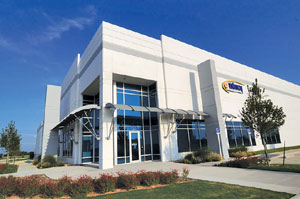
Why Athens? Michelle says it was the perfect storm of university support, federal and state tax credits for solar, and lots of natural sunlight beating down on the Appalachian region of Southern Ohio.
"We have about 4.2 hours per day of sunshine here in Southern Ohio," she says. "The highest amount is in California, where it averages 6.5 hours per day. We have 30-year data from the National Weather Service, and believe it or not, we actually have a better solar resource than Germany, where they are trying to replace all of their nuclear energy with solar energy."
Third Sun benefits from a state program that provides a $3-per-watt rebate to solar customers. "That usually pays for 30 to 40 percent of the cost of a system, or about $15,000 in credit to a homeowner," says Michelle. "Ohio also has a renewable portfolio standard. By 2025, 12.5 percent of the state's energy must come from advanced energy resources. There is a 3-percent carve-out for solar." (The state's RPS also calls for an additional 12.5 percent that is allowed to come from nuclear power plants, fuel cells, energy-efficiency programs and clean coal technology.)
Third Sun is part of a quickly growing cluster of alternative energy companies in Ohio, which led all states with 135 renewable energy manufacturing plant projects in 2008, according to the Conway New Plant Database. That total represents all projects in industry sectors that could conceivably be involved in the supply chain of producing green power, including healthy portions of materials and machinery activity.
Texas was second with 92 such corporate facility projects last year, followed by Pennsylvania with 86, Michigan with 75 and North Carolina with 44.
Edward Burghard, executive director of the Ohio Business Development Coalition, says by e-mail that while "other states are competing primarily on the harvesting side of the equation (with wind farms, solar collectors, etc.)," Ohio is building up a "leadership role on the R&D, manufacturing and supply-chain side of the equation. For Ohio, that is very exciting because it leverages existing global leading industry strengths in advanced design, advanced materials and advanced manufacturing."
That recipe of ingredients tends to produce growing firms like Third Sun, whose next step is to find a new home.
"We have identified some property and we are working with an architect," Michelle Greenfield says. "We will eventually do site development. There are some buildings in Athens that could be renovated, but we first have to ask ourselves, 'How big are we going to be?' "
Going Where the Wind Blows
A lot of wind energy companies are asking themselves that same question.
According to a recent report by Wind Powering America, the total installed capacity for wind power in the U.S. was set to reach more than 23,000 megawatts by the end of 2008. That total was up from just 2,500 megawatts in 2000.
While Texas and California have been the historic leaders in this sector, other states are making a strong run at the wind power category, according to site selection consultants who work in the industry.
"Colorado has been well positioned to serve the Midwest and Texas and still have access via rail through some of the northern passes in the Rockies to Washington and Oregon," says Ed McCallum, senior principal with McCallum Sweeney Consulting in Greenville, S.C. "Now that other states are coming on so strong, and with the inevitable creation of additional transmission capacity from remote areas to users, having one single plant to service all of North America may not be practical due to the sheer size of these units."
Transporting blades, nacelles and towers can become quite expensive, especially over long-haul distances, adding to the overall operating costs of wind manufacturing centers. The answer? Dispersal of operations to get closer to where wind farms are being built.
A case in point is the new Tower Tech Systems plant in Brandon, S.D., part of the Sioux Falls metro area. The $22-million investment creates 150 jobs in a 146,000-sq.-ft. (13,563-sq.-m.) factory for the manufacture of wind towers on a 20-acre (8-hectare) site in Minnehaha County.
"The first question we asked ourselves is this – 'Is there a viable market in that area for us to build and supply?' " says Paul Smith, chief operating officer of Tower Tech. "South Dakota is a very wind-friendly state."
"Alternative energy is a focus for us," says Jennifer Simon, president of the Athens County Economic Development Council. "We have a number of companies in the solar industry, and a lot of them are based on Ohio University's R&D."
Spearheaded by the OU Russ College of Engineering and Technology and the Consortium for Energy, Economics and the Environment at OU, the town of Athens, in the heart of Appalachia in southeastern Ohio, has quietly become a hotbed of solar and other renewable energy companies.
For a micropolitan area of just 63,000 people along U.S. Highway 33, these high-tech jobs are both needed and welcome, according to Simon.
"A company called Blight to Bright is taking old industrial areas around Athens and putting up solar farms there," says Simon. "An entrepreneur, Neal Lane, has been doing this in our area. He is brilliant. He is great on both the business side and the technology side. They are doing site selection and putting together a very strong business plan right now, and they are working throughout the state of Ohio with a partner on this."
Ohio's renewable portfolio standard of 25 percent by 2025 is a big reason for this, notes Simon, who says the wave of investment is spreading into other alternative energy fields as well.
"Sunpower is another pretty incredible company that started right here in Athens," she says. "William Beale invented the free-piston Stirling engine right here in Hocking Valley in 1964 and started the company ten years later. Today, we have our own little Silicon Valley of energy companies located here in Athens County."
Global Cooling grew out of that same technology in the 1980s. Today, it is a major company developing alternative refrigeration systems in Athens. "It is pretty interesting to see that progression from just one piece of research," says Simon.
At the OU College of Engineering, researchers have found a way to reduce the costs associated with making hydrogen for fuel cells. "That research has led to additional research and a bio-reactor with a couple different functions," Simon adds.
With 20,000 students, OU serves as the prime economic engine and largest employer in the Hocking Valley. Founded in 1804, OU is the oldest public university in Ohio and has been known throughout its history as one of the best schools in America for training teachers.
In 2006, twelve OU students received Fulbright scholarships. In 2005, the school had nine.
Room to Move
The company especially likes the Sioux Falls market. "That community is in an excellent location. We want to set up plants that size to feed our customers what they need conveniently," Smith says. "A lot of the cost of the tower is in the transport costs. That is why we picked that area geographically. We need a lot of area to stage towers for our customers. We needed a large plot for storing them."
With towers measuring 80 meters to 100 meters (263 to 328 feet) in length and weighing from 120 tons to more than 220 tons each, "we needed to build a facility big enough to produce and process them," notes Smith. "That was a big piece of it. We were looking at transportation infrastructure. We wanted a site with rail access. We also needed good access to Interstate highways and access to a labor demographic that makes sense for us. There are a lot of hard-working people in that area."
Jeff Eckhoff, executive director of the Minnehaha County Economic Development Association, says the company is building one plant in Abilene, Texas, in the heart of the country's largest wind-power corridor, and one in Sioux Falls.
"They began construction here last summer and had to postpone work while they focused on completing their plant in Texas," says Eckhoff. "Their plan is to resume construction soon in Brandon and complete the project by late summer. All of the infrastructure is in place. It is a building-ready site."
A division of Broadwind Energy out of Chicago, Tower Tech is making its first foray into South Dakota, notes Eckhoff. "The work force here was a big part of this deal. We had a job fair in Sioux Falls and over 200 people applied for these jobs even though we have an unemployment rate of only 2.5 percent."
Smith cites local and state help in picking the site and offering incentives, adding that both the Minnehaha County EDA and the Sioux Falls Development Foundation were "very, very helpful" in securing the deal.

The key industry to watch is solar power, says Don Schjeldahl, vice president and director of Austin Consulting in Cleveland, Ohio. "Where will the solar energy industry be located in the future? What will drive it? It won't be the European or Japanese model, which was to provide substantial incentives and feed-in tariffs to subsidize the electric power costs," says Schjeldahl, who heads up Austin's Renewable Energy Strategic Industry Group.
"We tend not to do that in the U.S. What must drive the market in the U.S. is grid parity – the idea that solar can be competitive with grid-bought power," he says. "Investment tax credits are very important, but ultimately the price of installed solar must be competitive with grid power."
NASA Center Could Lift Ohio Higher
On the space shuttle's latest mission to the International Space Station, the Atlantis crew delivered a structural support system that includes solar cell arrays similar to the one pictured above, as well as batteries and power conditioning equipment, all developed under the management of NASA's Glenn Research Center.
N
orthwest Ohio now is known as a nexus of the nation's $17-billion wind energy industry. As for the wind farms themselves, there are projects up and down the "North Coast" of Ohio, including a project in Lorain, and another being explored by NASA Glenn Research Center in Sandusky. Like other federal operations, the center is under the gun to produce 7.5 percent of its power from renewable resources by 2013.
Turbines or not, Glenn has provided power to the state's economy for a long time. As of April, it employed 1,508 full-time permanent employees, 17 part-time permanents, 64 term appointments and 17 students via co-op arrangements, for a total of 1,631 on the payroll.
"NASA Glenn continues to be an important economic player in Northeast Ohio and across the state," writes U.S. Sen. George Voinovich in an e-mail. "It is a vital component for both NASA and greater northeast Ohio, and I continue to support it. In fact, I recently led a letter with the Ohio delegation expressing a desire to work with President Obama to strengthen the presence of NASA in Ohio. I encouraged him to pay particular attention to the Glenn Research Center and its testing facility, Plum Brook Station.
"While my Ohio colleagues and I are excited by all the work that has been done to date, it is but the beginning of opportunities that will span generations," writes Voinovich. "Ohio has a skilled engineering labor force and manufacturers that have proven themselves on multiple NASA flight projects. When combined with NASA Glenn's experienced federal work force and world-class facilities, Ohio is a competitive choice for the location of additional contract and sub-contract work in design, development, manufacturing and testing."
U.S. Sen. George Voinovich
Could it have a role in the renewable energy sector itself?
"Many people don't know this, but between 1974 and 1981, NASA Lewis/Glenn led the U.S. Wind Energy Program for large wind turbines," answers Voinovich. "The technologies that were developed at Plum Brook Station and in Cleveland, Ohio, during this time period have paved the way for the advanced wind energy components being deployed by domestic manufacturers like GE, Owens Corning and others. Today, NASA Glenn continues to demonstrate technical excellence in the renewable energy field. Power research, technology and development at Glenn are addressing a wide range of renewable power needs, including solar cells, batteries, and advanced energy storage and conversion. The research currently being conducted could lead to commercial applications that could revolutionize our nation's solar and nuclear power industries, and allow for more advanced hybrid and electric vehicles."
– Adam Bruns
As electric utility rates inevitably rise around the U.S., solar energy will become increasingly attractive, the consultant notes. In fact, it's already happening in certain parts of the country.
"We are going to see a wave sweep across the country in the next five to 10 years," Schjeldahl says. "In the West, where the price of electricity is very high, we are already at grid parity in some places. The big run-up in production is going to be in the West. Making solar competitive is reducing the cost of the product. You have to make stuff for the local market, and the West is going to be the center of a lot of production."
The result is a lot of jockeying for position. "Everybody is rushing in, trying to get a piece of the market before the growth explodes. Then we will see pockets of manufacturing spring up as solar reaches grid parity regionally."
In the near term, says Schjeldahl, look for California, Oregon and Washington to continue to dominate the solar energy production market, particularly as long as electricity rates remain highest in the West. Other pockets of growth in the near future include New York and Boston in the Northeast, Albuquerque and Tucson in the Southwest, and Toledo in the Midwest, the consultant predicts.
Each market will likely carve out its own niche of the solar pie, he adds, "as there is a pretty robust value chain built around the photovoltaic sector – from the manufacturing of the polysilicon and gases, to glass manufacturing, to wafering and solar cell production."
In other words, advises Schjeldahl, there will be no one-size-fits-all solution to site selection for the solar industry; rather, the location strategies will depend upon the unique work being done in the value chain.
Sunny Outlook in Ohio
The brainchild of Geoff and Michelle Greenfield, the company has become one of the Midwest's leading solar contractors, installing rooftop solar panels on homes and businesses throughout the region.
Transplants from Oregon, the couple launched their business out of their home attic in Athens in 1997 and eventually moved into a business incubator at OU in July 2003.
Today, with 20 employees and over $3 million in annual revenue, the firm faces the challenge of dealing with growth that is expected to reach 300 percent this year, says Michelle Greenfield.
"We have installed over 250 solar systems in and around Athens," she says. "We live in a house that has never had a power bill in 11 years. We have lived off the grid for the past 11 years."
Entech Solar recently leased 71,250 sq. ft. (6,619 sq. m.) in the Fort Worth section of AllianceTexas. Entech is a leading provider of advanced solar energy technology. The company will also set up solar modules for testing on a nearby site. Hillwood Properties is the developer of AllianceTexas.
Why Athens? Michelle says it was the perfect storm of university support, federal and state tax credits for solar, and lots of natural sunlight beating down on the Appalachian region of Southern Ohio.
"We have about 4.2 hours per day of sunshine here in Southern Ohio," she says. "The highest amount is in California, where it averages 6.5 hours per day. We have 30-year data from the National Weather Service, and believe it or not, we actually have a better solar resource than Germany, where they are trying to replace all of their nuclear energy with solar energy."
Third Sun benefits from a state program that provides a $3-per-watt rebate to solar customers. "That usually pays for 30 to 40 percent of the cost of a system, or about $15,000 in credit to a homeowner," says Michelle. "Ohio also has a renewable portfolio standard. By 2025, 12.5 percent of the state's energy must come from advanced energy resources. There is a 3-percent carve-out for solar." (The state's RPS also calls for an additional 12.5 percent that is allowed to come from nuclear power plants, fuel cells, energy-efficiency programs and clean coal technology.)
Third Sun is part of a quickly growing cluster of alternative energy companies in Ohio, which led all states with 135 renewable energy manufacturing plant projects in 2008, according to the Conway New Plant Database. That total represents all projects in industry sectors that could conceivably be involved in the supply chain of producing green power, including healthy portions of materials and machinery activity.
Texas was second with 92 such corporate facility projects last year, followed by Pennsylvania with 86, Michigan with 75 and North Carolina with 44.
Edward Burghard, executive director of the Ohio Business Development Coalition, says by e-mail that while "other states are competing primarily on the harvesting side of the equation (with wind farms, solar collectors, etc.)," Ohio is building up a "leadership role on the R&D, manufacturing and supply-chain side of the equation. For Ohio, that is very exciting because it leverages existing global leading industry strengths in advanced design, advanced materials and advanced manufacturing."
That recipe of ingredients tends to produce growing firms like Third Sun, whose next step is to find a new home.
"We have identified some property and we are working with an architect," Michelle Greenfield says. "We will eventually do site development. There are some buildings in Athens that could be renovated, but we first have to ask ourselves, 'How big are we going to be?' "
Going Where the Wind Blows
According to a recent report by Wind Powering America, the total installed capacity for wind power in the U.S. was set to reach more than 23,000 megawatts by the end of 2008. That total was up from just 2,500 megawatts in 2000.
While Texas and California have been the historic leaders in this sector, other states are making a strong run at the wind power category, according to site selection consultants who work in the industry.
"Colorado has been well positioned to serve the Midwest and Texas and still have access via rail through some of the northern passes in the Rockies to Washington and Oregon," says Ed McCallum, senior principal with McCallum Sweeney Consulting in Greenville, S.C. "Now that other states are coming on so strong, and with the inevitable creation of additional transmission capacity from remote areas to users, having one single plant to service all of North America may not be practical due to the sheer size of these units."
Transporting blades, nacelles and towers can become quite expensive, especially over long-haul distances, adding to the overall operating costs of wind manufacturing centers. The answer? Dispersal of operations to get closer to where wind farms are being built.
A case in point is the new Tower Tech Systems plant in Brandon, S.D., part of the Sioux Falls metro area. The $22-million investment creates 150 jobs in a 146,000-sq.-ft. (13,563-sq.-m.) factory for the manufacture of wind towers on a 20-acre (8-hectare) site in Minnehaha County.
"The first question we asked ourselves is this – 'Is there a viable market in that area for us to build and supply?' " says Paul Smith, chief operating officer of Tower Tech. "South Dakota is a very wind-friendly state."
How a College Town Went Renewable
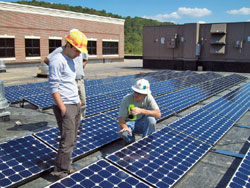
This 192-module Sunpower system atop a health clinic in Athens, Ohio, should produce at least 46,000 kilowatt-hours of power a year. Thanks to state and federal incentives, the for-profit business could realize savings of 65 percent on the $288,000 system.
W
hen the sun beats down on Athens, Ohio, it does more than warm the earth. It provides power for many homes and businesses in the Hocking Valley area and serves as a source of employment for a growing number of firms.
"Alternative energy is a focus for us," says Jennifer Simon, president of the Athens County Economic Development Council. "We have a number of companies in the solar industry, and a lot of them are based on Ohio University's R&D."
Spearheaded by the OU Russ College of Engineering and Technology and the Consortium for Energy, Economics and the Environment at OU, the town of Athens, in the heart of Appalachia in southeastern Ohio, has quietly become a hotbed of solar and other renewable energy companies.
For a micropolitan area of just 63,000 people along U.S. Highway 33, these high-tech jobs are both needed and welcome, according to Simon.
"A company called Blight to Bright is taking old industrial areas around Athens and putting up solar farms there," says Simon. "An entrepreneur, Neal Lane, has been doing this in our area. He is brilliant. He is great on both the business side and the technology side. They are doing site selection and putting together a very strong business plan right now, and they are working throughout the state of Ohio with a partner on this."
Ohio's renewable portfolio standard of 25 percent by 2025 is a big reason for this, notes Simon, who says the wave of investment is spreading into other alternative energy fields as well.
"Sunpower is another pretty incredible company that started right here in Athens," she says. "William Beale invented the free-piston Stirling engine right here in Hocking Valley in 1964 and started the company ten years later. Today, we have our own little Silicon Valley of energy companies located here in Athens County."
Global Cooling grew out of that same technology in the 1980s. Today, it is a major company developing alternative refrigeration systems in Athens. "It is pretty interesting to see that progression from just one piece of research," says Simon.
At the OU College of Engineering, researchers have found a way to reduce the costs associated with making hydrogen for fuel cells. "That research has led to additional research and a bio-reactor with a couple different functions," Simon adds.
With 20,000 students, OU serves as the prime economic engine and largest employer in the Hocking Valley. Founded in 1804, OU is the oldest public university in Ohio and has been known throughout its history as one of the best schools in America for training teachers.
In 2006, twelve OU students received Fulbright scholarships. In 2005, the school had nine.
– Ron Starner
Room to Move
With towers measuring 80 meters to 100 meters (263 to 328 feet) in length and weighing from 120 tons to more than 220 tons each, "we needed to build a facility big enough to produce and process them," notes Smith. "That was a big piece of it. We were looking at transportation infrastructure. We wanted a site with rail access. We also needed good access to Interstate highways and access to a labor demographic that makes sense for us. There are a lot of hard-working people in that area."
Jeff Eckhoff, executive director of the Minnehaha County Economic Development Association, says the company is building one plant in Abilene, Texas, in the heart of the country's largest wind-power corridor, and one in Sioux Falls.
"They began construction here last summer and had to postpone work while they focused on completing their plant in Texas," says Eckhoff. "Their plan is to resume construction soon in Brandon and complete the project by late summer. All of the infrastructure is in place. It is a building-ready site."
A division of Broadwind Energy out of Chicago, Tower Tech is making its first foray into South Dakota, notes Eckhoff. "The work force here was a big part of this deal. We had a job fair in Sioux Falls and over 200 people applied for these jobs even though we have an unemployment rate of only 2.5 percent."
Smith cites local and state help in picking the site and offering incentives, adding that both the Minnehaha County EDA and the Sioux Falls Development Foundation were "very, very helpful" in securing the deal.
Site Selection Online – The magazine of Corporate Real Estate Strategy and Area Economic Development.
©2009 Conway Data, Inc. All rights reserved. SiteNet data is from many sources and not warranted to be accurate or current.
©2009 Conway Data, Inc. All rights reserved. SiteNet data is from many sources and not warranted to be accurate or current.